The Platform
Platform Overview
Standards-driven compliance infrastructure for clinical accreditation. Six pillars, one data backbone, one rule engine. Country-agnostic, modality-agnostic, deterministic.
Clinical accreditation is a standards-driven, evidence-intensive process. Standards say what the evidence must show: appropriate use, technical quality, interpretive quality, report completeness and timeliness, current credentials, maintained equipment, met volume requirements. The Standards have been refined for decades by the societies that write them. They are not the problem.
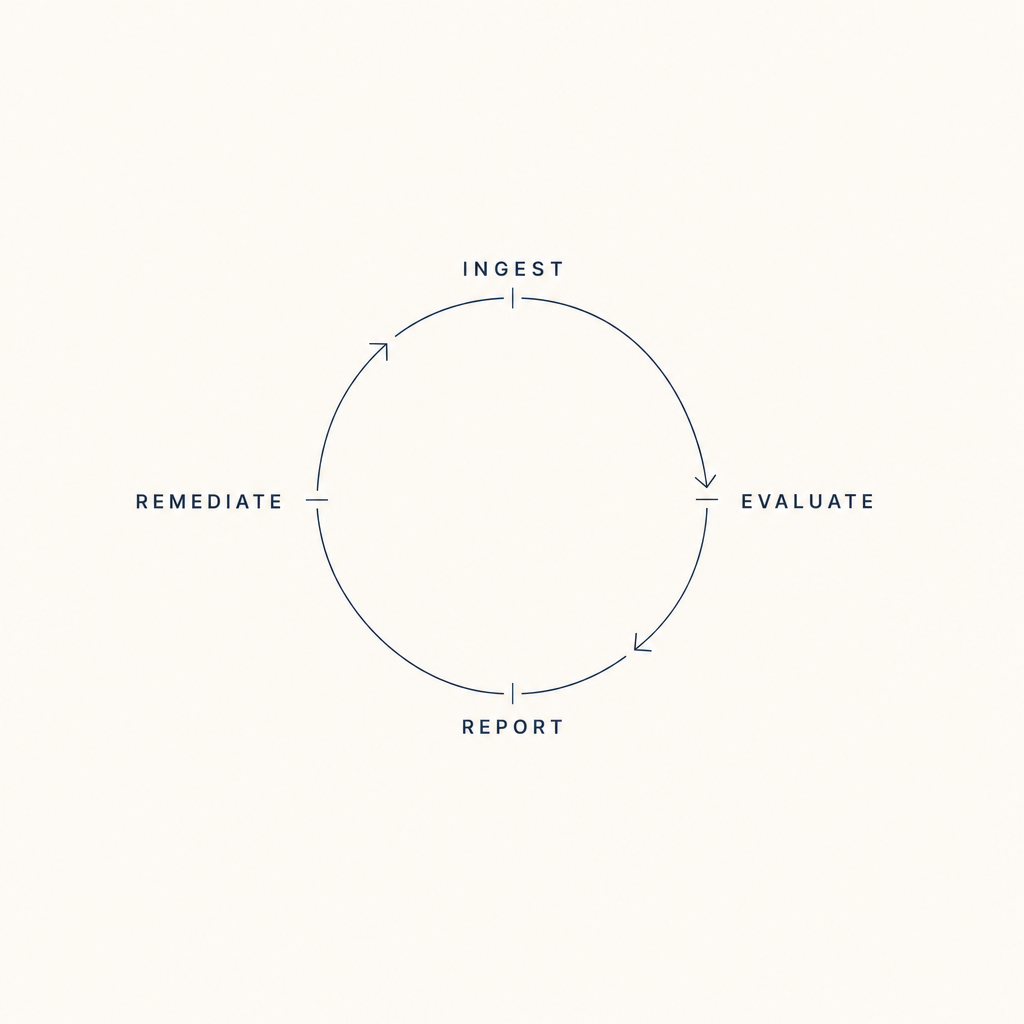
The evidence pipeline is. The evidence already exists, in the electronic medical record (EMR), in the credentialing system, in the equipment logs, and most facilities still compile it by hand once every three years. Gaps accumulate silently between cycles. Peer reviewers spend their time on completeness, not on the clinical judgment only they can provide.
Regain Accreditation is the substrate between the published Standards and the clinical data that proves a program meets them. Standards encoded as version-controlled rules. FHIR-native pull from the facility's clinical systems. Evidence accumulating continuously against the rule pack for that program area. Findings that cite the clause, the rule version, the metric, and the data the metric was computed from.
Six pillars, one data backbone
The substrate composes from six pillars running on a shared application substrate, a unified audit model, coordinated role-based access, and one evaluation surface, with protected health information held behind its own storage boundary by design.
Compliance Engine: Deterministic rule evaluation. The same inputs produce the same finding. No machine-learning model in the compliance path. Findings cite the clause, the rule version, the facility-level metric, and the dataset window the metric was computed over.
Clinical Data Pipeline: FHIR R4-native ingest from the facility's clinical systems, sandbox-tested. Code-system mapping for clinical observations. Derived evidence observations are hashed before evaluation. Volumes, reports, credentials, and equipment quality control (QC) flow into compliance evaluation without manual abstraction.
Reviewer Surface: Tooling that gives peer reviewers leverage on the work that requires clinical judgment. Mock surveys against encoded Standards. Gap analysis tied to the underlying metric. Cross-program standards mapping. Reviewers spend their time on what only reviewers can do.
Standards as Code: Standards encoded as version-controlled rule packs by program area. Semantic versioning. Priority-based composition. Conflict detection at load time. The engine is fixed; the Standards are configuration. New standards versions ship as rule-pack releases, not engine releases.
Multi-Accreditor Runtime: Modality-agnostic and country-agnostic standards runtime. The engine has been run against more than one published standards framework, with cross-framework mapping where rules overlap.
Clinical Grounding: Every rule traces to an authoritative source through a five-layer hierarchy: regulatory floor, the standards published by the societies that write them, peer-reviewed evidence, professional guidelines, emerging evidence. Higher layers take precedence. Enforced programmatically.
Architectural posture
Deterministic evaluation. The compliance engine is a rule evaluator. The same inputs produce the same finding, every run. Reasoning that proposes actions sits on a separate codebase from the evaluator that judges them. The audit trail does not pass through a language model.
Standards as configuration, engine as substrate. When a standards-issuing body revises its requirements, the change ships as a new rule-pack version. The evaluation engine does not need to be modified, retested, or redeployed. Rule-pack releases are independent of engine releases.
Structural independence of supervision. The supervisory layer that judges proposed clinical actions runs on a separate codebase, separate runtime, and separate access controls from the reasoning layer that proposes them. This is an architectural boundary, not a configuration toggle.
FHIR R4-native ingest. Backend Services authentication with RS384 JSON Web Token (JWT) signing, auto-pagination, and token-invalidation retry. Tested end-to-end against a public vendor sandbox. The same standards-based mechanism major health IT systems use for server-to-server communication.
What this looks like in practice
A quality coordinator opens the program's compliance posture on a Monday morning. The view shows current state against the Standards for that program area as of the last FHIR sync. A rule fired overnight because a staff competency assessment lapsed. The system has already linked the gap to the clause it implements, the metric it was computed from, and the underlying record in the source system.
No spreadsheet was consulted. No email was sent asking someone to check. Renewal is no longer a scramble, at the cycle boundary, the evidence is already compiled. The application is a review.
Provenance and scope
The team behind Regain Accreditation has field experience deploying clinical systems at medical centers in Central Asia. Regain, Inc. is a Delaware C-Corporation building toward HIPAA compliance with engineered separation of PHI and personally identifiable information (PII). Our Uzbekistan engineering company is backed by a World Bank-financed grant and an angel investment. The substrate is early in an industry transformation that will take years to complete.
In this section
Explore Platform.

Compliance Engine
Deterministic rule evaluation against the Standards for each program area. No machine-learning model in the compliance path. Same inputs produce the same finding, every run.

Clinical Data Pipeline
FHIR R4-native ingest from the facility's clinical systems. Standards-based authentication, automated LOINC and CPT mapping, SHA-256 evidence hashing, continuous sync into compliance evaluation.

Reviewer Surface
Tooling that gives peer reviewers leverage on the work that requires clinical judgment. Mock surveys against encoded Standards, gap analysis tied to the underlying metric, cross-program standards mapping, gated remediation drafting.
Standards as Code
Standards encoded as version-controlled rule packs by program area. Semantic versioning, priority-based composition, conflict detection at load time, machine-readable provenance on every rule.
Multi-Accreditor Runtime
One evaluation engine, modality-agnostic and country-agnostic by design. The engine has been run against more than one published standards framework, with cross-framework mapping where rules overlap.
Clinical Grounding
Every rule traces to an authoritative source through a five-layer hierarchy. Higher layers override lower. Enforced programmatically at pack-load time, not by policy.