Eight scenarios across the accreditation cycle, between-cycle visibility, sampling, peer-reviewer matching, application completeness, equipment quality control (QC), standards revision, remediation, and quality improvement. Each is described in generalized, modality-level language. Each anchors at the program at a facility, evaluated against its Standards.
How it lands
The cycle, the sampling, the friction, the substrate.
01
The Cycle
The accreditation cycle is years long. An application is filed, a decision is rendered, and the program runs against the Standards until the next renewal. Most of the work the Standards describe happens in the interval between cycles, where nothing structurally watches it. The unit of accreditation work is the program at a facility, evaluated across that interval, not the encounter, and not the organization.
02
The Sampling
Accreditors do touch case-level evidence, but only through sampling. A handful of cases are pulled per application for peer review against specific clauses. Equipment QC logs are uploaded. Credentials are verified. Volumes are tallied. Cases are sampled evidence, never the subject of accreditation, and never reviewed at population scale. The sampling is small because the labor of compiling it is large.
Cases are sampled evidence, not the subject of accreditation.
03
The Friction
The friction is uneven across the cycle and shared across the parties. Facilities scramble at renewal because nothing was compiled in between. Applications fail first-pass review on missing documents. Peer reviewers spend their time on completeness instead of clinical judgment. Equipment QC arrives as attestation rather than data. Remediation windows after a conditional decision pass without any structured way to show progress. Standards revisions take many months to ship through multi-gate review even when the addendum is non-binding.
04
The Substrate
The substrate watches the same evidence the Standards already describe, but it watches it continuously and at the program-area altitude. Sampling becomes structured. Application packages get pre-validated against the program's checklist before submission. Peer-reviewer assignment runs against structured matching with conflict-of-interest exclusions encoded. Remediation has a tracker. Standards-as-code means new rule packs ship as configuration releases, not engine releases. What follows is eight scenarios where this changes the work.
Three years is a long time for evidence to wait.
Where the work happens
Eight scenarios across the accreditation cycle.
Each scenario describes a pattern that recurs across modality-level accreditation programs, drawn in generalized form, with no specific program named. Read them as illustrative scenarios, not as customer case studies. The unit of work in every one is the same: the program at a facility, evaluated against its Standards across the cycle.
01
Between-cycle gap accumulation
The pain
Standards are evaluated against a multi-year batch at renewal. In between, gaps in technical quality, interpretive quality, or report completeness accumulate silently, because nothing structurally watches the program until the next application.
The substrate
Standards run as rule packs against the program's clinical data as the work happens. Compliance posture is visible continuously rather than reconstructed once every cycle, and renewal becomes a review of evidence already compiled, not a scramble.
02
Manual case-study sampling
The pain
Facilities submit case studies by hand. The cases that go to peer review are the ones the facility happened to find, not the ones best suited to test the clause they were sampled to test. Reviewers spend their time on completeness, not clinical judgment.
The substrate
Eligible cases are identified from the program's clinical data and surfaced as samples tied to the specific clause they exercise. Reviewers see the case, the clause it tests, and the underlying metric, and spend their time on judgment.
03
Peer-reviewer assignment friction
The pain
Matching peer reviewers to applications is combinatorial, specialty, geography, conflict-of-interest, and current load all constrain the assignment. The work gets done in spreadsheets and email, and the constraints get checked by memory.
The substrate
Reviewer pools, specialties, geographies, conflict-of-interest exclusions, and load are encoded as data. Structured matching proposes assignments against the constraints. Coordinators confirm, and the constraints are auditable.
04
Application completeness failures
The pain
Applications fail first-pass review on missing documents, an expired credential, a missing maintenance log, a volume tally that doesn't match its denominator. Each failure triggers a re-submission cycle that costs everyone time.
The substrate
Application packages are pre-validated against the program's checklist before submission. Missing items are surfaced while the evidence is still being compiled, not after the package has been filed. First-pass reviewers see a package that already passes.
05
Equipment QC self-reporting gap
The pain
Equipment QC arrives as PDFs and attestations. The Standards describe maintenance, calibration, and uniformity testing in structured terms, but the evidence shows up unstructured, because that's how the workflow has always produced it.
The substrate
Scanner logs and equipment maintenance records flow in directly where the data is structured, with PDF attestation kept only where it has to be. Cadence and threshold checks run against the log, not against a signature on a cover sheet.
06
Slow standards revision cycle
The pain
Updating the Standards runs through multi-gate board review and stakeholder consultation. Even a non-binding addendum can stretch over many months. The deliberation is appropriate; the distribution mechanism is what slows the work down.
The substrate
Standards live as version-controlled rule packs. A new pack is a configuration release, not an engine release, the deliberation happens at the standards body and the distribution happens at the substrate, on its own clock.
07
Silent remediation window
The pain
A facility granted accreditation conditionally has findings to close, but no structured way to show progress between the decision and the follow-up site visit. The window is silent. Both sides arrive at the visit with different beliefs.
The substrate
A remediation tracker is tied to the specific findings. The facility sees what is open, what is closed, and what the evidence shows. The accreditor sees the same view. Progress is structured rather than narrated.
08
Manual QI documentation
The pain
QI plans, meeting minutes, and peer-review documentation are compiled by hand at the end of the cycle. The four QI measures, appropriate use, technical quality, interpretive quality, report completeness and timeliness, get retro-fitted onto the artifacts.
The substrate
QI process artifacts are captured as structured records as the work happens, tied to the four measures the Standards already name. The QI plan reads against its own evidence rather than against a binder compiled the week before submission.
The thesis
The Standards already describe the work. The substrate is what watches it.
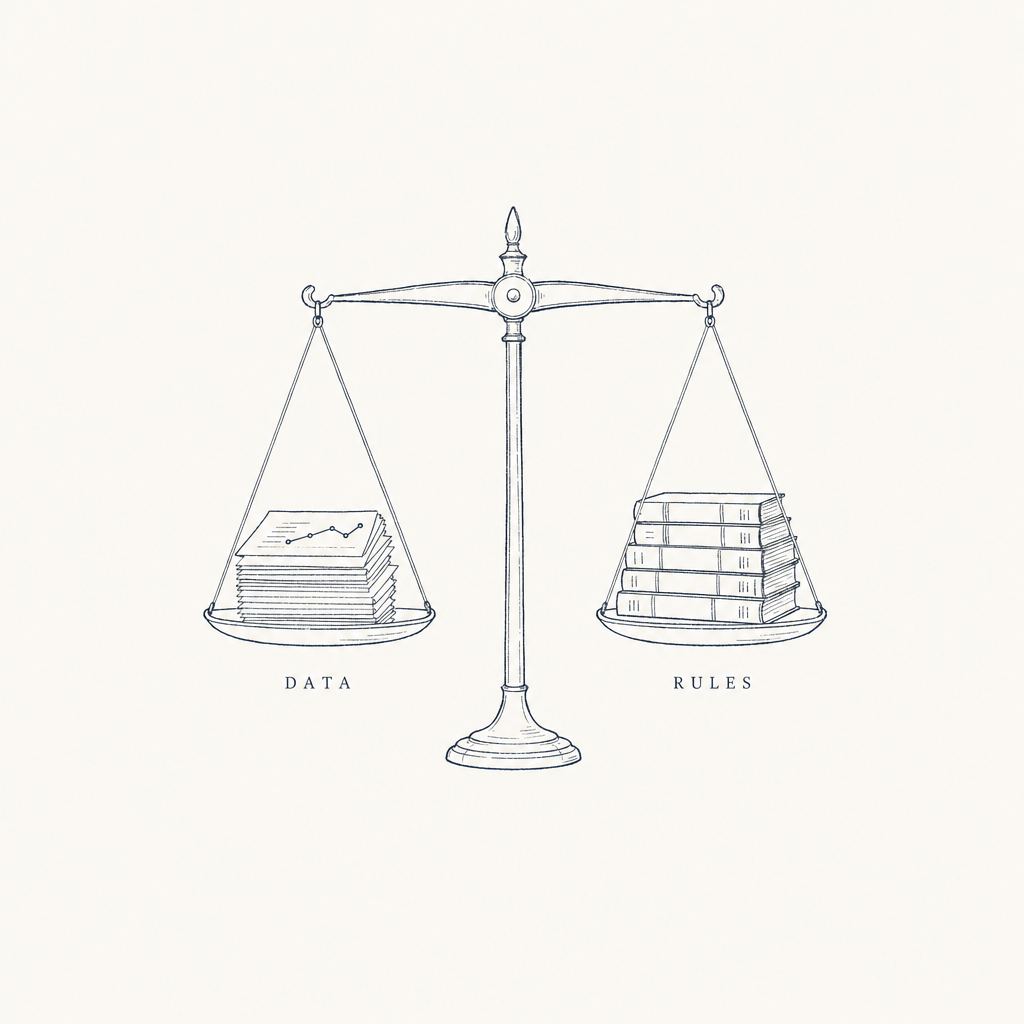
The eight scenarios describe different surfaces of the same structure. The Standards say what the evidence must show, appropriate use, technical quality, interpretive quality, report completeness and timeliness, credentialing currency, equipment maintenance, volumes met. The evidence is in the clinical data already. What is missing is the layer that watches that evidence accumulate against those Standards on a continuous basis.
Continuous visibility, structured sampling, encoded matching, pre-validated packages, structured equipment data, configuration-release standards, tracked remediation, captured QI artifacts, these are not eight products. They are eight surfaces of one substrate. The work shrinks because the substrate watches the evidence the Standards already describe.
Figure 4.1, Eight scenarios across the cycle, on one substrate
Figure 4.2
Where work lands across the cycle
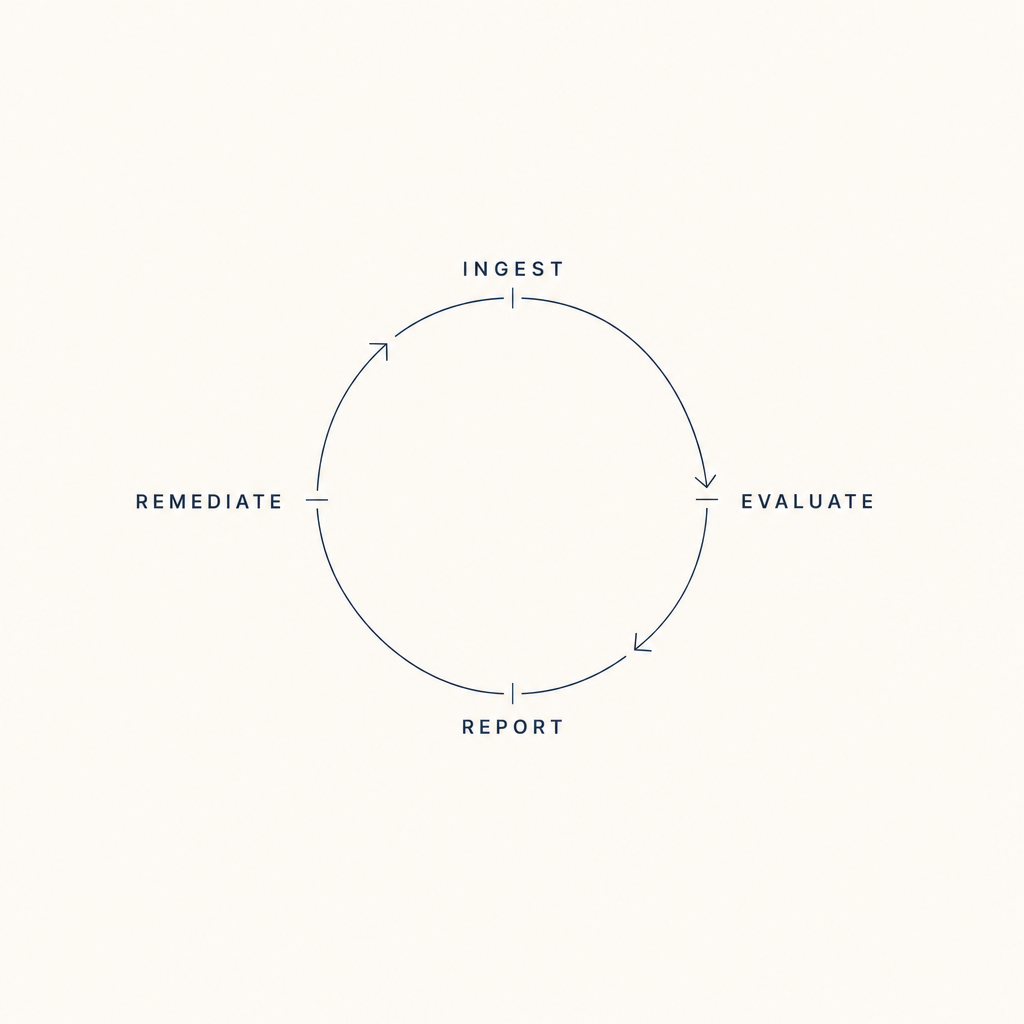
Illustrative composite, not customer data. The labor intensity in the status quo concentrates around application assembly and renewal, with the in-between interval mostly dark. The substrate redistributes the work continuously across the cycle so the application becomes a review rather than a scramble.
Read more
Adjacent sections.
Insights
Long-form analysis on the structural forces reshaping accreditation, visibility gaps, manual abstraction costs, voluntary standards, and the role of in-practice evidence in AI governance.
Deterministic evaluation, no large language model (LLM) in the compliance path, engineered separation of protected health information (PHI) and personally identifiable information (PII), and the reviewer-trust framing, how the substrate makes peer reviewers more effective.
A Delaware C-Corporation building clinical AI infrastructure. Our Uzbekistan engineering company is backed by a World Bank-financed grant and an angel investment. Field experience deploying clinical systems at medical centers in Central Asia. Building toward HIPAA compliance with engineered separation of PHI and PII.
Scenarios are drawn in generalized form from patterns that recur across modality-level accreditation programs. No specific accreditor, facility, or vendor is named or implied. Cases referenced in scenario 02 appear only as sampled evidence against specific clauses, consistent with standard practice across modality-level accreditation.
Scenario 06 references rule packs distributed as configuration releases. See platform / standards as code for the version-controlled rule-pack architecture.
Scenarios 02 and 05 reference structured ingestion from clinical and equipment systems. FHIR R4 ingestion is sandbox-tested; integration depth is per-facility. See platform / clinical data pipeline.
The four QI measures named in scenario 08, appropriate use, technical quality, interpretive quality, and report completeness and timeliness, are the QI framework most modality-level accreditation programs evaluate against.